As businesses move more services online, verifying customer identities securely has become an essential part of the onboarding process. From financial services and fintech companies to professional services firms, organisations need reliable ways to confirm who their customers are while delivering a smooth digital experience.
Traditional onboarding methods often rely on manual document checks, passwords, email verification and repetitive data entry. Although these methods remain useful in certain situations, they can create delays, increase administrative workloads and leave opportunities for identity fraud.
This is where biometric authentication solutions UK can make a difference. By using unique physical or behavioural characteristics, such as facial features or fingerprints, businesses can strengthen identity verification and support more secure digital onboarding.
When integrated into a well-designed onboarding workflow, biometric technology can help organisations improve verification processes, reduce friction and build customer trust.
What Are Biometric Authentication Solutions?
Biometric authentication solutions use an individual's physical or behavioural characteristics to verify or confirm their identity. Depending on the technology, these characteristics may include facial features, fingerprints, iris patterns or voice characteristics.
Unlike conventional authentication methods that rely primarily on passwords or access codes, biometric systems compare captured biometric information against a reference to assess whether the individual matches the expected identity.
Common biometric authentication methods include:
- Facial recognition: Analyses facial characteristics to verify an individual's identity.
- Fingerprint authentication: Uses fingerprint patterns to authenticate a person.
- Iris recognition: Examines distinctive patterns in the iris.
- Voice recognition: Uses relevant voice characteristics for identity verification.
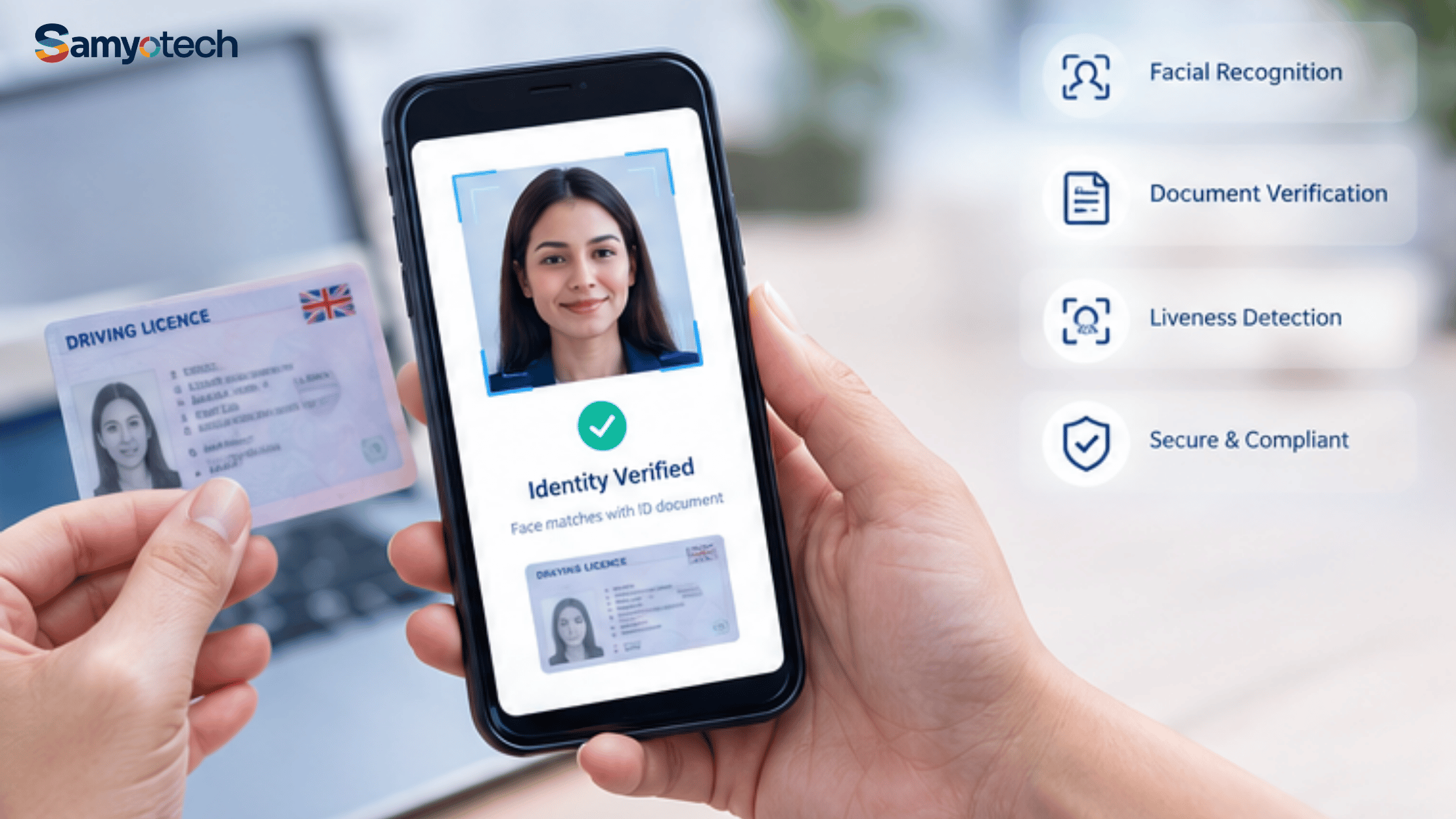
For digital onboarding, facial verification is particularly relevant because it can be combined with identity document checks and, where appropriate, liveness detection to help identify attempts to use photographs, recordings or other presentation attacks.
The effectiveness of a biometric system depends on its accuracy, implementation, security controls and the wider identity verification process.
How Biometric Authentication Supports Secure Onboarding
1. Strengthens Identity Verification
One of the primary benefits of biometric authentication is its ability to add another layer of identity verification.
During remote onboarding, a customer may submit an identity document and complete a facial verification step. The system can compare the captured face with the photograph on the document, depending on the solution's capabilities.
Additional checks can help assess whether the submitted evidence is genuine and whether the person appears to be physically present.
A well-designed biometric identity verification process can make it more difficult for someone to impersonate another individual using stolen personal information alone.
However, biometric checks should complement appropriate document validation, risk assessment and other verification controls rather than replace every identity check.
2. Helps Reduce Identity Fraud
Identity fraud can expose businesses to financial losses, operational disruption and reputational damage.
Biometric authentication can support fraud prevention by helping organisations detect identity mismatches and certain attempts to impersonate legitimate customers.
For example, a fintech company onboarding a new customer online could combine document verification, facial matching and liveness checks. Depending on the system, these checks may flag suspicious submissions for further investigation.
This layered approach can help businesses identify potential risks earlier in the onboarding journey.
Importantly, biometric verification does not eliminate fraud. Businesses should assess false acceptance rates, false rejection rates, spoofing risks and the need for manual review before relying on a solution.
3. Makes Digital Onboarding More Convenient
Security should not come at the expense of the customer experience.
Lengthy forms, repeated document requests and manual verification can frustrate prospective customers and cause some to abandon the onboarding process.
Biometric authentication can simplify parts of this journey by allowing customers to complete supported identity checks remotely, using compatible devices.
For example, an onboarding workflow might allow a customer to submit an identity document, complete a facial check and proceed to the next verification stage without arranging an in-person appointment.
When implemented effectively, this can reduce unnecessary steps and help businesses deliver a more convenient onboarding experience.
4. Supports More Efficient KYC Processes
Know Your Customer (KYC) procedures help organisations establish and verify customer identities as part of their risk management and compliance activities.
A biometric KYC solution can add identity verification capabilities to a broader KYC workflow. It may be integrated with document verification, customer information collection, screening tools and case management systems.
For example, a financial services business could use biometric verification during initial onboarding, then route failed or inconclusive checks to a trained reviewer.
This can help teams prioritise exceptions instead of manually reviewing every straightforward application.
Nevertheless, biometric verification alone does not complete KYC. Depending on the business, customer risk and applicable obligations, additional checks may be necessary, including customer due diligence, sanctions screening and ongoing monitoring.
5. Improves the Consistency of Onboarding Workflows
Manual onboarding processes can vary between employees, departments and locations. These inconsistencies may lead to missing information, duplicated work or incomplete verification records.
Integrating biometric checks into a structured onboarding workflow can help standardise how identity verification steps are initiated, recorded and escalated.
Businesses can define verification stages, establish review procedures and maintain appropriate records of relevant decisions.
For organisations managing large customer volumes, this approach can improve process visibility and make it easier to identify bottlenecks.
Explore how custom compliance and RegTech solutions for UK businesses can support more structured digital compliance workflows.
Key Considerations When Implementing Biometric Authentication in the UK
Although biometric authentication offers potential benefits, businesses must evaluate privacy, security and operational requirements before implementation.
UK GDPR and Biometric Data Protection
Under UK GDPR, biometric data processed for the purpose of uniquely identifying an individual is special category personal data. Organisations must identify an appropriate lawful basis under Article 6 and a separate condition under Article 9, alongside meeting other applicable data protection requirements.
Businesses should also consider:
- Transparency: Explain what biometric information is collected, why it is needed and how it will be used.
- Data minimisation: Collect and retain only the information necessary for the defined purpose.
- Security: Apply appropriate access controls, encryption and safeguards for stored and transmitted data.
- Retention: Establish clear retention and deletion policies.
- Privacy impact assessments: Assess whether a data protection impact assessment (DPIA) is required, particularly where processing is likely to create a high risk to individuals.
Explicit consent may be an appropriate condition in many circumstances, but it is not automatically the right choice for every use case. Organisations should assess their specific circumstances and seek specialist advice where necessary.
For further guidance, consult the Information Commissioner's Office (ICO) guidance on biometric recognition.
Accuracy, Bias and Accessibility
Biometric systems can produce false matches or reject legitimate users. Performance may also vary across demographic groups, devices and operating conditions.
Businesses should evaluate independent testing, performance data, accessibility requirements and the availability of alternative verification methods.
A clear process for manual review and handling unsuccessful checks can help prevent genuine customers from being unnecessarily excluded.
Integration With Existing Systems
Biometric authentication should fit into the wider onboarding journey rather than operate as an isolated tool.
Organisations should consider how the solution integrates with their CRM, KYC platform, document management system and compliance workflows. Integration requirements, data flows and access permissions should be assessed before deployment.
How to Choose the Right Biometric Authentication Solution
Selecting an appropriate solution starts with understanding the business's onboarding requirements and risk profile.
Consider these five factors:
- Verification capabilities: Confirm which biometric methods, document checks and liveness detection features are supported.
- Security and privacy: Review data handling practices, storage arrangements, retention policies and security controls.
- Regulatory suitability: Assess whether the solution supports the organisation's specific legal and compliance obligations.
- Integration: Check compatibility with existing systems and the complexity of implementation.
- User experience: Evaluate mobile compatibility, accessibility, verification speed and alternative routes for customers who cannot complete biometric checks.
The right solution should balance security, operational efficiency, privacy and customer convenience.
Frequently Asked Questions
What are biometric authentication solutions used for?
Biometric authentication solutions help verify or authenticate individuals using characteristics such as facial features, fingerprints or iris patterns. Businesses may use them as part of digital onboarding, account access and identity verification workflows.
How does biometric identity verification support KYC?
Biometric identity verification can help compare an individual's biometric information with an identity document or another authorised reference. It supports the identity verification stage of KYC but does not replace other required due diligence checks.
Is biometric authentication secure for online onboarding?
It can strengthen online onboarding when combined with appropriate document checks, liveness detection, secure data handling and human review. No biometric system is completely immune to fraud, technical errors or privacy risks.
Do UK businesses need to consider GDPR when using biometric authentication?
Yes. When biometric data is processed to uniquely identify an individual, it is special category personal data under UK GDPR. Businesses must establish the required legal grounds, implement appropriate safeguards and meet relevant transparency and accountability obligations.
Conclusion: Build More Secure Digital Onboarding
Secure onboarding requires more than confirming that a customer has submitted the correct information. Businesses need reliable identity checks, consistent workflows, appropriate fraud controls and careful handling of personal data.
Biometric authentication solutions in the UK can support these objectives by strengthening identity verification, helping detect impersonation attempts and simplifying selected stages of digital onboarding.
However, successful implementation depends on choosing suitable technology, integrating it with wider KYC and compliance processes, and addressing privacy, accuracy and accessibility from the beginning.
At Samyotech, we help businesses explore technology-led approaches to compliance and digital transformation.
Explore our compliance solutions to learn how tailored technology can support your business processes, or contact Samyotech to discuss your requirements.
Build a more secure, efficient and scalable onboarding experience with the right technology.